Ganjifa is a term commonly used for hand-made and hand-painted traditional playing cards prevalent in India since medieval times. The art and games of these cards gained popularity in India during the 16 th century and especially under the rule of Mughal emperor Akbar.
Ganjifa cards are of historical importance besides holding aesthetic and artistic value. They serve a social purpose by bringing people together, providing entertainment and by popularising socio-cultural themes. The cards are also used as souvenirs.
This unique fine art form blends the exquisite art of painting and craft. At the same time, as a game, it grew in popularity during the 18 th and 19 th centuries among a cross-section of people. It was quite common to find people playing a game of ganjifa in temple court-yards, homes, market places and within the precincts of the royal court. It served as a form of entertainment and created an atmosphere of devotion, as the players chanted the names of their favourite deities while dealing the cards.
The production of ganjifa cards has never been on a mass scale but made exclusively on commission. Unfortunately, the arrival of modern printed playing cards affected the market of these indigenous hand-painted ganjifa cards. But even with a decline in demand, a few artists continued the practice of painting the traditional themes and at times incorporated the traditional theme to suit the structure of the modern pack of 52 cards. In course of time the number of practitioners decreased mainly due to lack of regular patronage and sustainable income. The legacy, however, continues in the hands of a few artists whose families have pursued the ancient practice of ganjifa painting.
The themes portrayed in the ganjifa packs range from the social to religious ones. The choice of subjects has always reflected the socio-religious trend in society.
The most important cards known as court cards are the Mir/Raja/King and Wazir/Pradhan/Minister along with Rani in some sets. These are known as court cards which hold great value. The remaining motif and numeral cards indicate the respective suit symbol. The court cards represent the court figures and are stylistically rich and reflect the artistic and aesthetic dexterity of the artist. In contrast, the numeral cards are decorative and yet simplistic in their application and nature of painterly treatment.
The material used for preparing ganjifa cards has varied from ivory, mother of pearl, wooden tablets, sandalwood, lac, patta (rag) and card-sheet. While royal families and the rich by and large commissioned cards made with expensive material, people and artists in general used the more affordable material such as waste paper and fabric.
The ganjifa cards vary in size and shape. While the most common indigenous card is circular in shape, a few sets are occasionally found in square and rectangular shapes.
Indian playing cards are packed in painted boxes that represent the respective regional style of painting. Made of light wood all the boxes have a sliding lid but vary in size and shape.
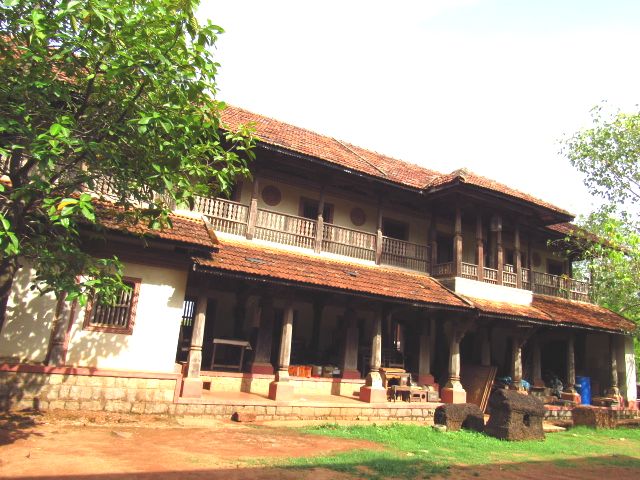
The Ganjifa Art Gallery that the Hasta Shilpa Trust has set up in its Heritage Village presents a comprehensive spectrum of ganjifa themes and style in practice and are illustrative of both individual and regional stylistic variations that are representative of Sawantwadi, Sonepur, Chikiti, Puri, Raghurajpur, Bishnupur, Nirmal and Mysore.
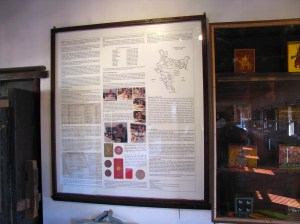
There are 52 panels in this Gallery that display a reasonable variety of ganjifa cards and are representative of a range that includes the expertise of a 19 th Century artist like. Na. Ra.Kelkar and other noted artists practicing since the early 20 th century. The Gallery houses some rare 19 th century Mysore cards along with a printed set dated 1940 produced at the Chitrashala Press, Pune in Maharashtra. The panels present the standard Dashavatara cards and its variations, Mysore Chad, Mughal Ganjifa and variations such as Arundhati and Saptarishis, Navadurga, Navagraha, Rashi Ganjifa, Ramlila, Sonepur Ramayana Ganjappa, Naqsh and even a tarot set. Each panel is provided with details regarding the set, cards on display and certain salient aspects.
The curating and display of panels at the Gallery was taken up by Dr Pramila Lochan (art historian) and late Mr Kishor Gordhandas (collector).
To know more about Heritage Village and the stupendous contribution in its development by founder Sri. Vijaynath Shenoy, please visit < indiaheritagevillage.org>
 dr pramila lochan